At CHAMPS Glass Games, the clock is part of the artwork. Artists enter with a theme, a set of preparation limits and a fixed amount of working time. The finished piece carries those constraints with it, even when the audience only sees the final table.
That makes the competition worth understanding on its own terms. CHAMPS is a trade-show setting, but the Glass Games have a separate structure: qualifying events, different live formats and a Masters final. A dramatic photograph of finished glass tells only one part of what an artist had to accomplish.
For people following cannabis events through the High Rise calendar, this is a useful distinction. A show can contain business meetings, vendor displays and a competitive art program at once. Knowing which part interests you makes the event easier to follow and the results more meaningful.
How the circuit leads toward a final
The organizer’s Glass Games event pages describe a circuit rather than one isolated contest. Different stops carry their own programs, so a rule from one edition should not automatically be applied to another. The current listing is the place to check a specific city’s competition and associated activities.
For example, the Austin listing for October 13–15, 2026 places the show at Palmer Events Center and identifies October 15 as the competition day. That is a specific edition’s schedule. It should not become a permanent description of when Austin competes, or a promise about future years.
Following the circuit also changes how you read a final. The artists have reached a particular stage through the organizer’s competition structure. A Masters result is therefore part of a longer sequence, with earlier events and qualification paths behind it. The final table is where that sequence becomes most visible.
You do not need to memorize every stop to appreciate the work. Start by identifying the edition, the format and the theme. Those three details provide enough context to understand why a particular piece exists and what the artist was responding to during the event.
The 2026 Masters had a defined challenge
In its May 25, 2026 recap, CHAMPS reported that the Masters final ran May 6–9 at the Las Vegas Convention Center. Twenty-four artists, qualified through the 2025 circuit, received fourteen hours of torch time for the theme “From Inner Space to Outer Space.”
The organizer named Niko Cray as the winner, with a $20,000 first prize. Ryno placed second and Burtoni third. The judging panel consisted of Dave Strobel, Micro and Cool Hand Suuze. These are results from that completed edition, not the terms of a future competition.
A shared theme makes the final interesting beyond ranking. Every entrant begins with the same verbal prompt but can choose a different interpretation. As a viewer, compare how the idea appears in form, composition and detail. You can notice those choices without pretending to know what happened at every workstation.
The time limit adds another layer. A finished object reflects choices about what to attempt and what could be completed within the available hours. That does not let an outside viewer reconstruct the artist’s entire process. It does give the audience a concrete constraint to consider when looking at the final work.
Preparation rules protect the live element
The standard preparation rules draw a line between permitted starting material and finished components. They allow specified forms of tubing and rod while restricting pre-shaped or completed sections. Judges and event staff can assess whether a component crosses that line.
The rules also address particular inclusions and exclude certain prepared elements. They warn that entries using infringing trademarked or copyrighted imagery can be removed and disqualified. Artists should read the complete current rules for their event, because a short description cannot replace the actual competition requirements.
For spectators, the broader point is easy to understand: the organizers want meaningful work to happen on site. Preparation can support the performance without becoming the finished performance. That boundary gives the clock a purpose and helps explain why a contest needs more than a theme and a prize.
It also changes how an audience should respond to an ambitious piece. The question is not simply whether the object looks elaborate. It is how the artist worked within the permitted starting conditions. Without those conditions, two finished pieces might appear comparable even though the competitors faced very different tasks.
A smaller format can ask a different question
The published 2025 Mini Masters program provides a useful historical example. It described a six-and-a-half-hour competition under the theme “Expanding Consciousness,” with prepared material constrained to a four-inch cube. Its qualification terms pointed toward the 2026 Masters.
That archive should be read with its year attached. It does not establish the rules for every future Mini Masters edition. What it does show is that the circuit can change the scale and available time, asking artists to solve a different version of the live competition problem.
A smaller preparation allowance can make the starting point especially easy for an audience to picture. The box is a physical boundary, while the clock supplies a temporal one. Together they help viewers understand that a competition piece is a response to a defined brief, not simply a studio object brought in for display.
When comparing editions, keep those briefs visible. A longer Masters format and a shorter contest may reward different decisions about complexity and finish. Ranking the resulting objects against each other without their conditions would erase part of what makes the events distinctive.
Different awards capture different responses
The 2026 recap also reported separate audience and artist selections: Solfire received People’s Choice, while Charisma received Artist’s Choice. Those awards sit alongside the panel’s placements. They give the final more than one record of how the work was received.
That separation is useful for an audience. A jury result tells you what the appointed panel selected. An audience award reflects another constituency, and an artists’ award adds a peer response. The existence of different winners does not make the results contradictory; the awards are asking different groups to make a choice.
Cannabis events use many approaches to judging. Our Zalympix guide explores a separate product-competition setting. Glass Games belongs to its own format, where the live making process and an artistic brief matter. Keeping those formats distinct makes both easier to appreciate.
Watch the work, then keep the context
If you are following through photographs, save the artist’s name and the edition alongside the image. Look for the organizer’s result rather than guessing a placement from an enthusiastic caption. A striking piece can circulate far beyond the original post, losing its date and competition context along the way.
If you plan to attend a future stop, check the show’s current admission terms and the specific Glass Games schedule. Do not assume that a competition listing establishes public access to every part of a trade show. The program and the entry requirements answer different planning questions.
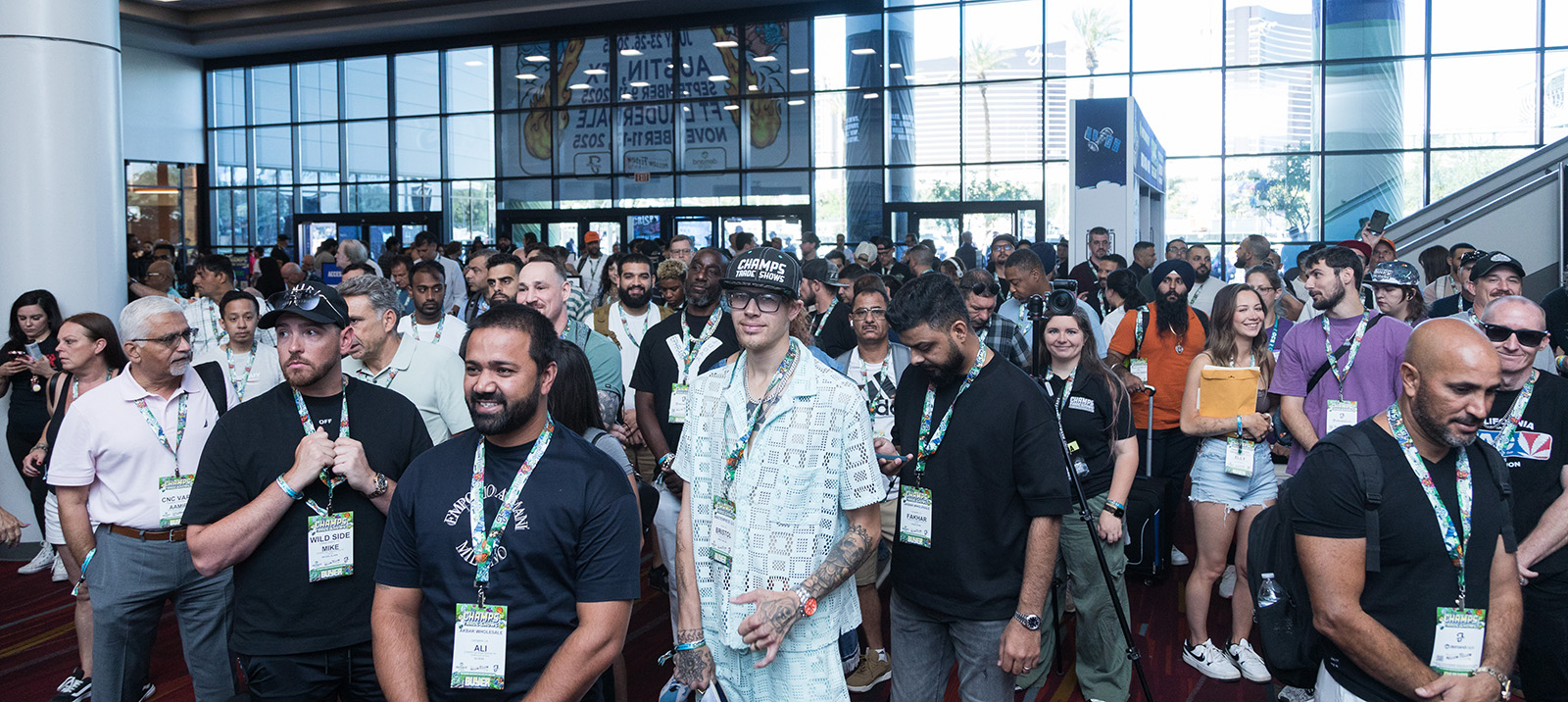
The archival attendee photograph accompanying this article comes from CHAMPS’ own site. It shows the wider show environment, not the 2026 Masters final or a particular winning piece. That broader setting helps place the competition without using an unrelated image as evidence of the results.
Glass also has a life after the event: in collections, interiors and the stories people tell about the maker. Our Houseplant home decor coverage looks at another part of that design conversation. Competition brings a different emphasis, putting a deadline and a shared challenge around the act of making.
That is the reason to follow Glass Games beyond the winner announcement. The circuit gives artists a stage, the rules define the challenge, and the finished work records a set of choices made under pressure. Knowing those conditions lets the audience see more of what is sitting on the table.