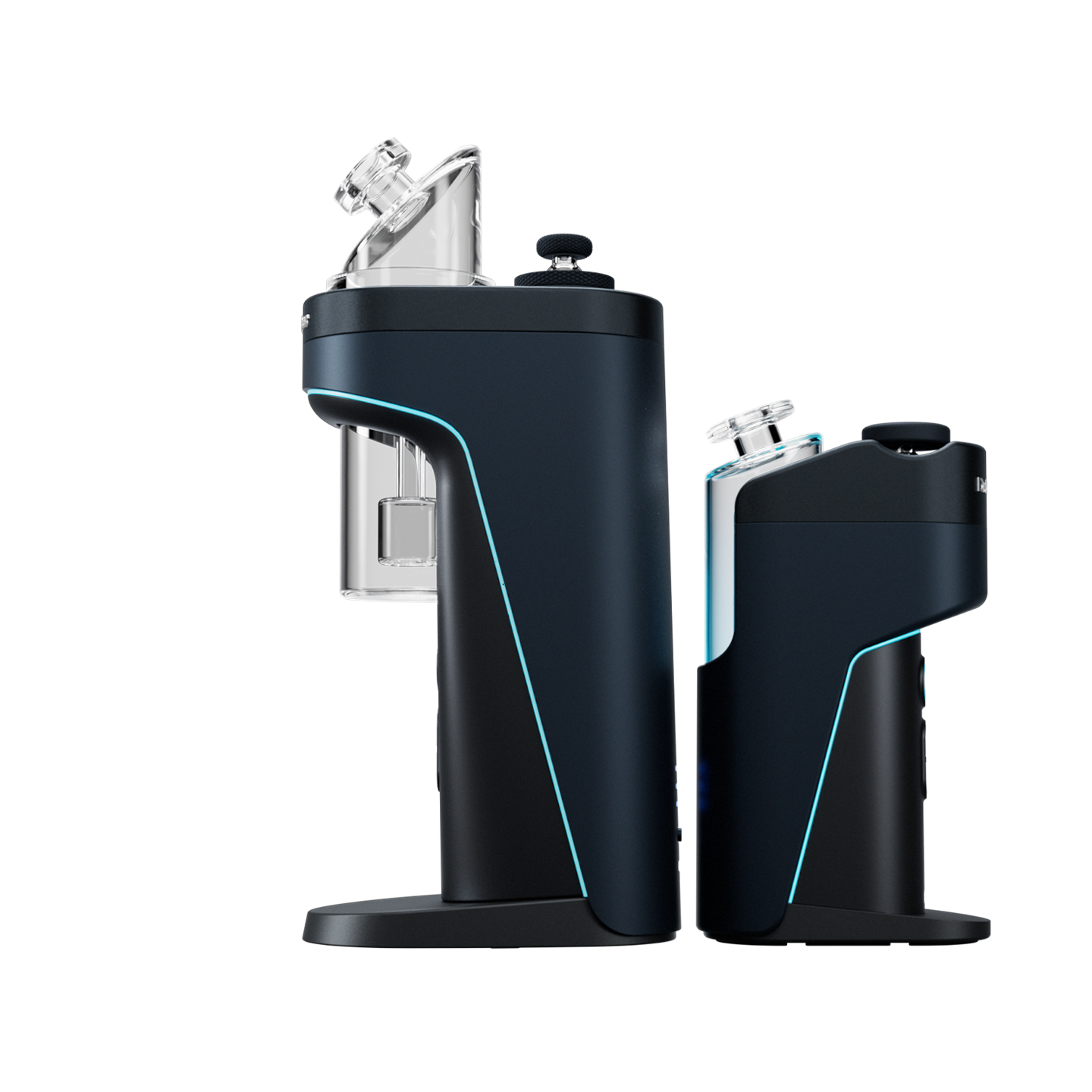
Dr. Dabber’s Switch GO and Switch² share a family name, but the difference is more substantial than shrinking the shell. GO is the smaller device, with a smaller quartz insert and a shorter published charging time. Switch² keeps the larger home-oriented format, a 20 mm insert and documented induction heating with infrared temperature sensing.
Choose GO when the size of the assembled rig is your main constraint. Choose Switch² when it will mostly stay in one place and you specifically want its heating architecture or larger insert. Neither recommendation requires pretending that smaller automatically means worse or larger automatically means better.
This comparison uses current manufacturer specifications and support documents. It does not present a hands-on temperature test, durability trial or personal battery benchmark. Where the company’s pages disagree, the claim stays limited to the page that actually makes it.
The size difference you can measure
The Switch GO product page lists a height of 6 inches, width of 3.3 inches and weight of 12.8 ounces. The Switch² page lists 9 inches, 4 inches and 25.6 ounces. On those published weights, GO is half as heavy.
That is a concrete reason to consider GO if your existing rig feels oversized for the space available. It is still an assembled device with a glass attachment. “Portable” should mean easier to pack, not permission to treat it like an unbreakable object.
Switch² asks for more room in storage and on the surface where it sits. In return, the larger platform accommodates its larger insert and hardware. Whether that trade works depends on your space and the features you want, not on which model has the longer specification list.
A useful comparison includes the protective bag or case you intend to use. The device’s bare dimensions tell only part of the story. Add the clearance needed around the glass before deciding either setup fits a particular compartment.
The heating systems should not be conflated
Switch² explicitly uses induction heating. Its official page also describes an infrared sensor and a 20 mm quartz insert. Those are specific hardware claims tied to the larger model. They should not be copied into a GO description just because the devices share a name.
The Switch GO knowledge base describes dual parallel heating and a 14 mm single-crystal quartz insert. Its sensor terminology is inconsistent elsewhere on that page, so we are not presenting GO as a smaller unit with a verified copy of Switch²’s infrared system.
The practical distinction is straightforward: check the mechanism for the model you are buying. If induction and infrared sensing are the features that interest you, Switch² documents them explicitly. If your priority is the smaller body and removable insert, evaluate GO on that basis.
Our Switch² product feature provides context on the larger device. The family resemblance should help you navigate the range, not blur the differences between generations and models.
Quartz inserts are parts, not lifetime promises
Both models use removable quartz inserts, with different published sizes. Dr. Dabber emphasizes a design that avoids the familiar replacement-atomizer routine. That does not make the glass, quartz or other removable components impossible to damage.
An insert is still a physical part that must be handled and cleaned. GO’s support page specifically describes quartz and sapphire inserts as fragile and says inserts are not covered under warranty. Read the coverage for each component instead of translating “no atomizers” into “nothing can ever need replacing.”
The smaller and larger insert dimensions also should not become an unsupported performance ranking. A larger opening may suit someone who prefers more working room. It does not prove superior results for every owner or justify recommending a larger amount of concentrate.
When comparing costs, identify the replacement insert for the exact device. A Switch² part listing is not evidence of GO compatibility. The model name on the accessory matters just as much as it does on the rig.
Controls remain useful without a constant phone session
Both product families offer app customization. Switch²’s page describes control over temperatures, hold times, lighting and dynamic heating modes. GO’s support documentation also describes custom settings that can be retained for use through the unit’s buttons.
That distinction is useful for buyers who want to configure a device once and then put the phone away. App-enabled does not necessarily mean app-required for every ordinary interaction. Verify which controls are available onboard and which settings require the connected interface.
Dr. Dabber describes heating profiles that change the target temperature over time, alongside a steady mode. The meaningful feature is the ability to shape a profile. We are not treating the manufacturer’s promotional descriptions as proof of a particular sensory result.
If you have no interest in customizing anything, avoid paying for features you will leave untouched. On the other hand, if your current device’s fixed presets are the problem, configurable profiles are directly relevant to the purchase. Start with the limitation you want to remove.
Battery ratings need a source label
The current product pages rate GO for up to 20 heating cycles and Switch² for up to 30. GO’s page lists a 45–60 minute full charge; Switch² lists 60–90 minutes. Both specify USB-C pass-through charging. These are published ratings, not our measured results.
There is a documentation mismatch worth understanding: GO’s support page separately mentions up to 25 cycles. That inconsistency prevents a single guaranteed number from being presented honestly. We use the product-page figure here and would not base a purchase on the more optimistic number alone.
Longer settings and other operating choices can affect runtime. A count of heating cycles also is not the same as a count of days between charges. Your charging schedule depends on how frequently the device is used and configured.
For a mostly stationary setup, charging access may matter more than the advertised maximum. For a rig that spends more time packed away, the ability to recharge conveniently becomes part of the decision. Neither scenario needs an exaggerated battery-life claim to be useful.
Cleaning access and finish care matter
GO’s knowledge base separates the glass, crown, insert, heating chamber and exterior finish in its cleaning instructions. That is a reminder to treat the device as several materials with different care requirements, rather than one object that takes one cleaning treatment.
The page explicitly warns against using isopropyl alcohol on the Blue Onyx outer shell because it can damage the finish. It also cautions against removing hot inserts. Those details matter more than a vague promise that the device is easy to clean.
Follow the current instructions for the particular model and component. Do not transfer a procedure from an older Switch, an XS or another manufacturer solely because the devices look related. Allow cleaned parts to dry completely before reassembly and operation.
Our Dr. Dabber XS review covers another compact format in the lineup. Its smaller size does not turn its maintenance directions into a universal Dr. Dabber manual.
Compare the box, not only the base
The GO product page lists the rig, quartz insert, glass attachment, carb cap, dab tool and USB-C cable. Switch² lists the device with a glass attachment, carb cap, USB-C cable, charging adapter and Drop heated loading tool. Confirm the current listing because bundles can change.
That difference affects a price comparison even if you never buy another accessory. A package with a charging adapter and heated tool should not be compared with a differently equipped package as though the contents are identical. Likewise, an extra included item has little value if you already own one.
The listed warranties differ too: GO’s page specifies one year for its battery, charger and electrical components; Switch² specifies two years for those components. Coverage terms and exclusions still apply. These periods do not establish how long either device will last.
For an additional reference point, our Boost Evo review discusses another Dr. Dabber device. Keep the model boundaries clear when comparing accessories, controls and replacement costs across the range.
The decision comes back to your space
GO makes sense when you want the smaller assembled rig and accept the smaller insert and lower product-page battery rating. Its value is the combination of size, removable parts and configurable controls. It does not need to be described as a miniature copy of every Switch² feature.
Switch² makes sense when the rig will have a regular place at home and its documented induction system, infrared sensing or larger insert are the reason you are buying. The extra size becomes a trade you accept for specific features.
Before ordering, identify your exact configuration, charging setup and replacement parts. Then compare current prices for those complete kits. The better purchase is the one whose actual hardware fits your routine, with enough information to understand what you are getting.