A pocket rig still has to earn its pocket space
The Dr. Dabber Ghost² puts a surprisingly busy control system inside a small body. Its appeal is specific: five temperature presets, three heating modes and a ceramic mouthpiece, operated from one button. The tradeoff is equally specific. You get a compact concentrate device with its own small parts and upkeep, rather than a tabletop rig shrunk without compromises.
The maker lists a height of 3.5 inches, a width of 1.7 inches and a weight of 7 ounces. That gives the compact claim some actual dimensions. Compare those measurements with the space you have, then look beyond the shell. The controls, chamber and mouthpiece determine what ownership involves after the device leaves its box.
Dr. Dabber listed the Ghost² at $119.95 and in stock on October 29, 2026. The standard package contains the vaporizer, a loading tool and a charging cable. This is a documented hardware assessment; High Rise has not conducted a hands-on test of the model.
The familiar name belongs to a different design
In a company interview about the redesign, CEO Jamie Rosen dates the original Ghost to 2013. He identifies the newer model’s compact form, ceramic pathway and selectable heating modes as central changes. The name supplies continuity, but it should not invite assumptions about interchangeable parts or identical operation.
Rosen also connects those modes with the Switch². That is a relationship between control concepts, not proof that the devices share their entire heating architecture. Our Switch² product guide covers the larger induction-based tabletop setup. The Ghost² uses a different chamber arrangement and a mouthpiece built into its compact top assembly.
That distinction keeps a comparison useful. Someone choosing between these formats is choosing how much equipment they want around them, as well as which controls they want available. A portable device can be the better physical fit without needing to win an imaginary contest against every larger rig.
Temperature and heating mode answer different questions
Dr. Dabber specifies five presets spanning 420–540°F. Ascent, Descent and Steady then control how the heating profile behaves: rising, falling or holding. Think of the preset as one decision and the direction of the profile as another. Three modes do not mean three additional temperature presets.
That extra layer makes the Ghost² more involved than a device whose only choice is a color. It also gives a buyer a concrete way to assess the feature. If you want fixed presets and never intend to change the profile, the additional modes may be secondary. If you specifically want control over the profile’s direction, they belong near the top of your comparison.
The Ghost² manual assigns different button sequences to temperature selection, heating, mode changes and battery status. It uses moving lights to distinguish the modes. The interface therefore trades separate switches and a screen for a handful of sequences the owner needs to learn.
One button is a tidy piece of industrial design. It is not the same thing as one function. Before buying, look at the actual control diagram and decide whether its signals make sense to you. A device can be physically simple while still asking you to remember how its interface behaves.
Our broader guide to e-rigs without an app explores that controls question across other models. Here, the useful distinction is narrower: the Ghost² combines preset selection and profile selection on the device itself. Neither feature establishes a particular sensory result.
The mouthpiece reveals the ownership routine
The replacement mouthpiece listing names three components: a silicone top, a ceramic mouthpiece and an airflow regulator. That matters more than the assembly’s smooth exterior suggests. The top is a small group of parts, and the owner will handle those parts when cleaning and reassembling it.
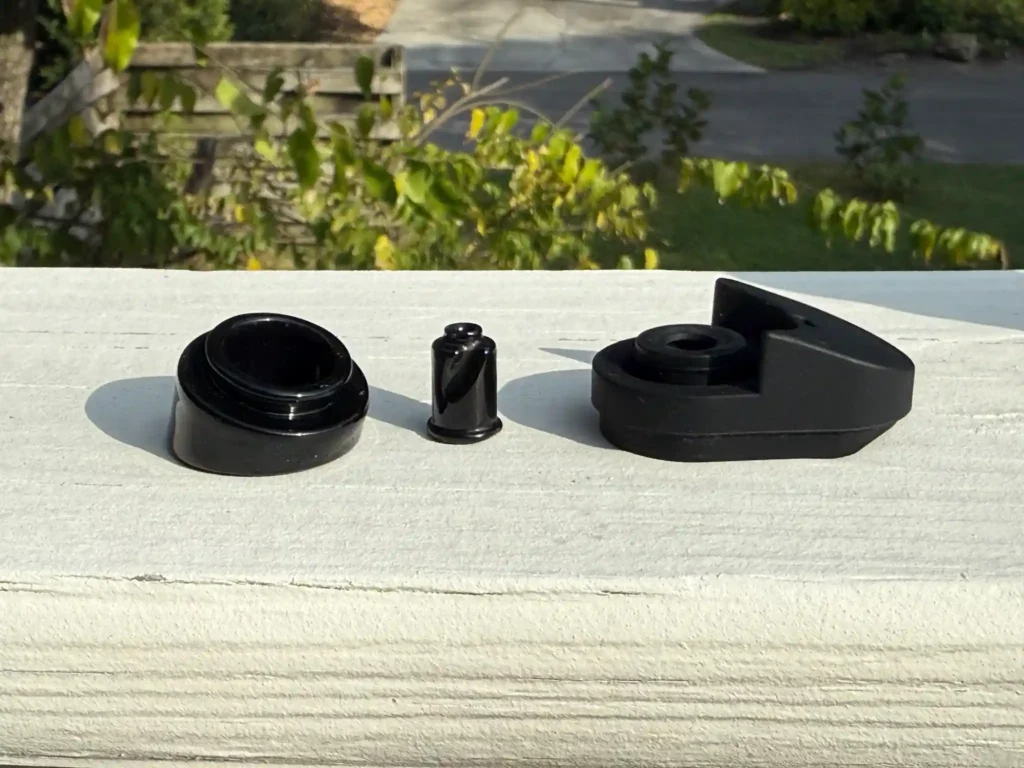
The photograph makes that distinction tangible. A compact outer shape can conceal several surfaces and connections. Someone who enjoys understanding their hardware may appreciate that accessibility. Someone expecting a sealed object with nothing to remove should study this view before treating the Ghost² as a maintenance-free purchase.
The maker labels the replacement assembly as compatible only with Ghost². A familiar logo is not enough when ordering a spare. Match the complete model name, and distinguish the whole assembly from an individual component. That avoids buying a similarly named part whose physical connection belongs to another device.
The chamber deserves its own line in the budget
Dr. Dabber describes the Ghost² replacement eChamber as a full ceramic dish with a knurled exterior. Its listing also limits compatibility to Ghost². The chamber and mouthpiece are separate replacement identities, even though both disappear into the same compact silhouette when assembled.
For a buyer, that creates two useful questions. Can you obtain the correct replacement locally or directly from the maker? And does the seller clearly identify what its bundle includes? A discounted kit and a kit with a spare chamber are different offers. Compare their actual contents before deciding which price represents better value.
Do not infer a replacement interval from the existence of a spare-parts page. The listing establishes the part’s identity, not how long every owner’s chamber will last. Nor does it establish today’s inventory at every retailer. Availability and replacement cost deserve a fresh check when you make the purchase.
Battery claims need their conditions attached
The maker advertises up to 20 heating cycles per charge, a 45–60-minute full charge and USB-C pass-through charging. Those are manufacturer specifications. They describe the product’s advertised capability, rather than a promise that every combination of settings and use will produce the same count.
In its Ghost² hands-on article, Troy and Jerry ThinkDank reports 15 cycles using Cyan, Descent mode and 30-second cycles. The writer also reports heat-up times of 15–20 seconds, depending on remaining battery. Those observations belong to that reviewer and those conditions.
The useful reading is not to average the figures into a new specification. An advertised ceiling and one documented experience answer different questions. Keep both attached to their source. If battery endurance is your deciding factor, seek tests that describe the settings and cycle length clearly enough to compare.
Small does not remove the care requirements
The manual calls for cleaning the removable mouthpiece components and swabbing the chamber. It also requires the parts to dry before operation and shows the correct airflow-regulator orientation. Those details make the upkeep more specific than simply wiping the outside and putting the device away.
Chamber replacement has another step: the manual specifies calibration at room temperature. Follow the current illustrated instructions for that procedure rather than improvising from a different Dr. Dabber model. Keep the manual available alongside the exact replacement-part names; both are useful beyond the first day.
The one-year warranty covers the battery, charging cable and electrical components. It excludes the chamber, mouthpiece, accessories, cosmetic issues and damage from improper use. Third-party purchases require proof of purchase. Those boundaries should inform the ownership budget, especially when comparing a used device with a new kit.
Buy the format you actually want to keep
The Ghost² makes the most sense as a deliberate choice of compact format and onboard control. Its strongest documented distinction is the combination of five presets, directional heating modes and a removable ceramic mouthpiece assembly. None of that erases the small-part handling or the need to buy model-specific replacements.
Use the High Rise hardware directory to compare physical formats, then return to the exact kit and parts list. Choose the Ghost² because those choices fit your priorities. The attraction is a compact setup whose controls remain on the hardware. The decision comes down to whether its shape and parts fit your routine.