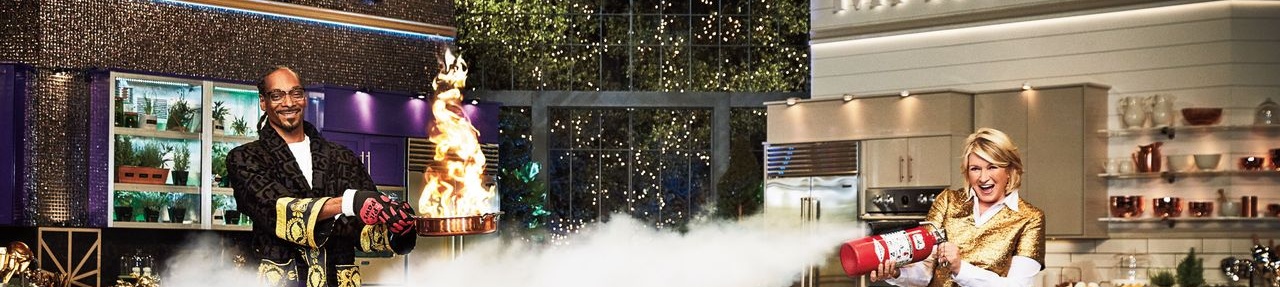
Martha Stewart holds a fire extinguisher. Snoop Dogg holds a flaming pan. In a 2016 promotional photograph for Martha & Snoop’s Potluck Dinner Party, the kitchen behind them is divided between two unmistakably different styles. The image gives the show a premise before either host says a word.
The VH1 series launched on November 7, 2016. Ten years later, its original design is still a useful way into the program: two hosts with established worlds of their own, a meal to prepare and other people invited into the process. The table gives all that personality somewhere to meet.
Their first cooking appearance together was on Martha’s show in 2008. The later series made a recurring setting for the pairing. Food, guests, music and conversation could share the same evening, with the work of hosting connecting them.
The meal gives the conversation somewhere to go
Before the premiere, Stewart described the original format to Architectural Digest as a food-themed talk show. Guests would participate in preparing the meal, then everyone would sit together to talk and eat. That description makes the shared activity central to the invitation.
A meal supplies a sequence: preparation, decisions, something to finish and a reason to gather afterward. A conversation can move through that sequence with the people doing the work. The guest has another way to participate beyond answering questions about a career or promoting the next project.
That is part of what makes the idea suited to television. Cooking creates objects and actions for the camera to follow. The table then gives the participants a different arrangement, with attention moving among several people. The kitchen and the meal serve different parts of the same encounter.
The original invitation also allowed several kinds of expertise to enter the room. Stewart’s interview named guests including Seth Rogen, Wiz Khalifa and chef Masaharu Morimoto. An actor, a rapper and a chef bring different public identities to a shared food theme. The format gives them a common activity without requiring identical skills.
Two kitchens make the pairing visible
Stewart’s side of the set used creams and copper, with marble surfaces and farmhouse references. Snoop’s side brought purple, gold and a sparkling purple stand mixer. In the same interview, Stewart described the kitchen as having a split personality. The contrast was designed into the space.
That choice keeps both hosts legible. One person does not have to disappear into the other’s familiar setting. A viewer can recognize two separate visual worlds inside the same production, then watch how the program proposes to bring their owners together.
The shared table is the other half of that design. Separate kitchen identities establish the pairing; sitting down together gives it a destination. The movement from individual space to a common meal is a simple structure with room for a rotating group of guests.
Rogen’s own work offers another route into cannabis and design. Our Houseplant home-decor feature follows objects intended to occupy a room. Here, the room itself helps explain the creative proposition. Color, tools and surfaces can carry a host’s identity alongside the dialogue.
The table could take a changing cast
A June 2017 release from VH1 announced the second season’s October return through a list of food themes, guests and performers. Its variety-show possibilities appear in the combinations of people and food themes.
A chili cook-off listed Don Cheadle, Sherri Shepherd and Rozonda “Chilli” Thomas, with a musical performance by Kyle. A burgers evening listed RuPaul and Faith Evans, with Evans also identified as performing. A pasta theme paired Steve Aoki with Wendi McLendon-Covey. These were the network’s announced combinations for that season.
The food theme does useful organizing work. It gives an evening a recognizable subject while allowing the guest list to cross music, film and comedy. A performer can have more than one place in the program: someone at the table may also be part of the entertainment.
By 2019, the format became a contest
The original dinner-party description belongs to a particular version of the show. A March 2019 network announcement introduced ten battle-themed specials under the title Martha & Snoop’s Potluck Party Challenge. Hosts and teammates would compete in culinary challenges, with a celebrity judge awarding the Potluck Party Platter.
The announced April 3 launch paired Matthew McConaughey and Method Man, with Isla Fisher judging. That arrangement gave guests defined positions within the competition. They could participate as teammates or assess the result, while the hosts’ pairing remained at the center.
The change is worth keeping in view when returning to older material. The original invitation emphasized making a meal and talking around the table. The later announcement added teams, a judge and a prize. Those versions organize attention differently, even with the same familiar hosts.
It also gives the anniversary a more substantial story than a fixed image of the duo. The kitchen could support a conversation-led evening, then become the setting for a competition. A shared creative idea can acquire a different set of rules as its producers develop it.
The hosts were part of the production, too
The 2017 announcement credited Stewart and Kim Miller Olko for Sequential Brands Group, Snoop and Ted Chung for Merry Jane, and SallyAnn Salsano for 495 Productions as executive producers. VH1 had its own executive producers. The hosts’ names therefore appeared within the production arrangement as well as at the front of the show.
Those credits add a working dimension to the pairing. A public personality can appear as a guest, host a program or participate in the production making it. Here, the announcement identifies several of those relationships instead of presenting the series only as a spontaneous dinner between famous friends.
For cannabis culture, Merry Jane’s place in the credits is a specific connection worth retaining. It puts the company inside a television production alongside the network and other partners. That relationship is more informative than assuming every familiar cannabis reference belongs to the same business.
Artist-led media can take several forms. Our BREAL.TV profile follows a network organized around B-Real’s hosted conversations and programs. Potluck Dinner Party built a different setting around two hosts. In each case, the format deserves attention alongside the recognizable person introducing it.
A shared nomination names the hosting work
The Television Academy’s record lists Stewart and Snoop as hosts in the show’s 2017 nomination for Outstanding Host for a Reality or Reality-Competition Program. Both names appear in that single show entry. It gives the collaboration a precise place in the awards record.
Hosting with another person creates a particular assignment. Each host needs room to contribute, while guests need room to enter the exchange. The central pair can establish the program’s identity, but keeping a table open to other people is also part of the format’s promise.
Cannabis culture has room for different screens
Bell Media’s November 2016 announcement placed the series within Gusto’s food-and-lifestyle schedule, alongside cooking and wine programming. That historical placement shows another part of the crossover: a program involving Snoop could sit inside an ordinary evening of food television.
A documentary can ask a different question of the same cultural world. Our feature on Fab 5 Freddy’s Grass Is Greener follows a filmmaker’s approach to music and cannabis history. A host-led dinner series organizes an encounter; a documentary can organize an argument through its interviews, music and archive.
These forms need not stand in for one another. The original Potluck Dinner Party materials offer a specific creative idea to revisit this anniversary month: give two hosts distinct spaces, invite other people into a shared task and bring everyone to the table. The setting does a good deal of the explaining.