Miss Grass is easiest to understand if you read it before looking at its products. The brand's archive contains founder essays, arguments about cannabis culture and the announcement of its own pre-rolls. That sequence matters. The writing shows what the company wanted to say before every conversation had to begin with a package, a flavor or a new product format.
Founded by Kate Miller and Anna Duckworth, Miss Grass launched in January 2018. Its story sits at the meeting point of women-led media and a cannabis company building its own products. The interesting question is how those two roles interact. A brand can introduce people to the culture while selling into it, but its commercial position should remain visible alongside its editorial voice.
A brand with an editorial starting point
The founders' essay about sanitizing cannabis culture looks back at the January 2018 launch and explains the audience they hoped to represent. They describe wanting a broader account of the people who consume cannabis, rather than another narrow stereotype. The essay places that ambition inside the company's origin story. It is a statement of purpose from the people building the business.
That framing gives the archive a different character from a collection of product announcements. The founders are making an argument about representation: who gets welcomed, who gets dismissed and what parts of the culture remain visible. The argument does not require every reader to share their preferences. It asks why those preferences should determine which people are treated as acceptable participants.
Miss Grass's founder page identifies Miller as CEO and co-founder, alongside co-founder Duckworth. Keeping those names attached to the early writing is useful. A brand voice can sound impersonal when its opinions float without authors. Here, the archive provides a way to connect the company's position to people who publicly articulated it.
The early argument was about belonging
The sanitizing-cannabis essay pushes back against dividing consumers into respectable and disreputable groups based on which part of the plant they prefer. Its central cultural objection is exclusion. The founders argue that a company should not gain acceptance by distancing itself from the people and practices that preceded it. That is a sharper position than the usual promise to make a category approachable.
It also gives readers a standard against which to examine the brand's later work. Does the product language invite people into a wider culture, or suggest that only one kind of consumer belongs? Does the imagery leave room for different identities? Those questions can be asked without turning a company's mission statement into proof that it has met every ambition it describes.
For a women-led cannabis brand, representation can become a shallow aesthetic very quickly. A color palette alone cannot explain whose experience is being represented. Miss Grass's early essays offer more material to work with: named authors, an argument and a public archive. They make the company's perspective available for scrutiny, rather than asking the audience to infer it entirely from the packaging.
The conversation extends beyond ingredients
In an essay on conscious cannabis consumption, Duckworth and Miller argue that buying decisions involve more than the contents of a product. Their discussion includes the people behind companies and the politics surrounding the industry. It is an opinion piece with a clear position. Reading it as such preserves the distinction between the brand's argument and an independently established account of the whole market.
The useful cultural point is that a cannabis company cannot remove itself from the surrounding industry simply by presenting a polished object. Its history, relationships and public choices remain part of the story. That does not make packaging irrelevant. It means packaging is one piece of the evidence, rather than the complete explanation of what a company stands for.
Our feature on cannabis mylar becoming gallery material follows a different connection between products and their surrounding culture. The physical package can carry references that outlast the thing inside it. Miss Grass's essays work through language instead. Both invite a closer look at what cannabis objects communicate beyond their immediate commercial purpose.
Minis brought the audience into a product story
The Miss Grass Minis launch announcement describes asking its audience what it wanted in a cannabis product. Among the requests reported by the brand were pre-rolled joints, a smaller format, considered packaging and accessible pricing. The announcement presents Minis as the result of that conversation. It does not publish a survey methodology or establish that those preferences represent every cannabis consumer.
That distinction keeps the story in proportion. An audience conversation can help explain a company's decision without becoming a universal market finding. What matters here is the sequence Miss Grass chose to describe: ask, develop, then introduce a product. Its readers were part of the product narrative, rather than an audience encountered only after the launch was complete.
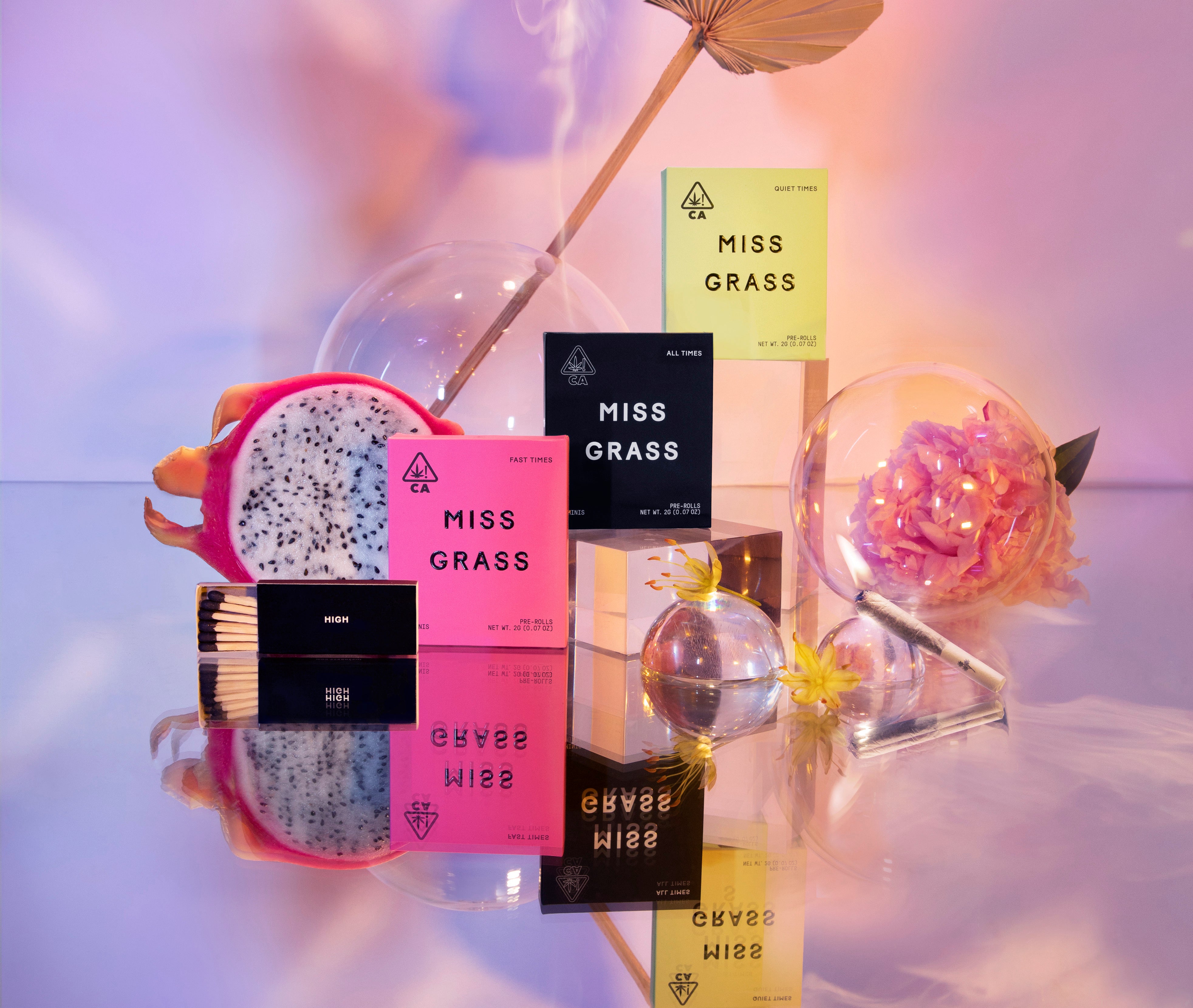
The original announcement names Fast Times, Quiet Times and All Times. Those names organize the product family through a shared verbal structure, while the campaign image separates the packages through color. The system is easy to recognize across several objects. Its design can be discussed on those terms without turning the names into promises about what anyone will experience.
The package belongs to a larger visual world
In the photography from its Clio Cannabis packaging entry, three Miss Grass jars sit on plinths against mirrors. Reflections repeat the containers without changing their shapes. The arrangement gives the labels room to be read, while the different label colors distinguish each jar within a recognizable product family.
The design also has named contributors. High Tide’s Miss Grass case study credits its collaboration with the brand’s internal team and Vedros Studio, with Meryl Vedros responsible for the wordmark. The studio describes combining serif and sans-serif typography with an eclectic palette. Those credits connect the visual identity to actual design work, rather than leaving it as an anonymous brand aesthetic.
Compare that approach with the objects in our Houseplant home-decor feature. The creators and products are different, but both stories invite attention to what remains visible in a room. A cannabis-related object can be considered for its form, material and relationship to other things. It does not have to disappear from the visual conversation once its basic purpose is understood.
The distinction between product formats matters too. A small pre-roll and the format covered in our hash-hole explainer should not be treated as interchangeable simply because both arrive rolled. A brand profile becomes more useful when it preserves those differences. Design language can connect products culturally without erasing what makes each object structurally distinct.
The later writing returns to the same tension
Kate Miller's essay on normalizing the plant rather than a format revisits the earlier argument through the rise of cannabis drinks. She welcomes new formats while objecting to language that presents existing ones as less respectable. The connection to the older essay is explicit. The subject has changed, but the concern about cultural exclusion remains recognizable.
This continuity is more revealing than a claim that the brand has always stayed perfectly consistent. The archive allows readers to compare two stated positions across different moments. In both, the question is what gets left behind when a company tries to make cannabis more acceptable. That is a real tension for any brand presenting itself to a new audience.
It is also a useful distinction for discovery. A new product can expand someone's options without supplying a verdict on everybody else's choices. That leaves room for different objects, different scenes and different preferences to coexist. A cannabis publication should be able to examine those differences without turning every product story into a ladder of cultural respectability.
Read the archive alongside the shop
The current Miss Grass site places products and editorial material within the same destination. That arrangement is central to the brand's identity, but it also means readers should notice which role a page is playing. A founder essay offers a point of view. A product announcement explains what the company is selling. Neither becomes more useful when the distinction disappears.
For readers discovering Miss Grass now, the early essays and Minis announcement provide a compact route into its history. They explain the audience question, the brand's position and the transition into its own product line. The later writing then shows how that argument continues. There is enough continuity to follow without assuming every old product description represents the current catalog.
Miss Grass's most interesting contribution is the insistence that cannabis culture deserves a larger account of who belongs. Its products make that position tangible, while its archive makes it possible to examine the words behind it. Read both together. The packaging introduces the brand quickly, but the essays explain what it wants that introduction to mean.