A glass piece can carry an artist’s signature, a shop’s identity and a collector’s memories. In 2003, federal prosecutors placed another meaning on the object: evidence in a national drug-paraphernalia investigation. Operation Pipe Dreams brought the businesses surrounding cannabis into the same public argument as the plant itself.
Tommy Chong became the most recognizable face of that history. His name connected the case to comedy, film and a generation that already knew his public persona. But the investigation reached beyond one performer. Looking at the original announcement, contemporary sentencing reports and later cultural records reveals a larger story about glass, commerce and who gets to define an object.
That history still belongs in a conversation about cannabis design. High Rise has followed packaging into galleries in Get to the Bag. Pipe Dreams asks us to look at an earlier moment, when the public debate around an accessory could determine the fate of the business selling it.
The announcement was bigger than one name
The Justice Department’s February 24, 2003 announcement described Operation Pipe Dreams alongside a separate investigation called Operation Headhunter. For Pipe Dreams, it reported 27 people charged in 17 indictments. The broader coordinated enforcement announcement covered 55 people across 35 indictments.
Those figures describe charges announced at that moment, not a single shared outcome for everyone involved. The distinction matters when this history gets compressed into a celebrity anecdote. A national enforcement action contains separate defendants, businesses and proceedings. Chong’s later sentence cannot stand in for what happened to every other person named.
The government’s announcement focused on distribution, including internet sales. It also named glass businesses and people working within that trade. That makes the document useful beyond its headline numbers: it shows how federal authorities framed the commercial network surrounding the objects, from sellers to the channels reaching customers.
Read as a cultural artifact, the release is striking for its language. Officials were arguing about the social meaning of the merchandise as well as its distribution. Their characterization represented the prosecution’s position. It should be understood as an official argument, rather than a neutral description of everyone who made, sold or owned glass.
The internet was part of the story
Today, a maker’s website can feel like the most ordinary part of an independent business. It gives the work a home, makes the artist identifiable and connects people across distance. In the 2003 announcement, federal officials treated online distribution as a central feature of the enforcement problem they wanted to address.
That contrast gives Pipe Dreams a particular place in cannabis history. The dispute was not confined to what happened inside one local shop. It also concerned how products circulated and how easily customers could find them. A business’s ability to reach beyond its neighborhood became part of the public case against that business model.
For a reader looking back, the useful question is how the same commercial tools acquire different meanings in different settings. A catalogue can introduce an artist’s work. It can also become a record of what a company offered. The object, its description and the distribution channel all sit within the story.
That does not mean every accessory company faced the same circumstances or legal result. It means the original announcement deserves to be read before treating the case as a simple clash between one famous comedian and the government. The business network was there in the document from the beginning.
What the contemporary reports say about Chong
NORML’s September 18, 2003 report said Chong received a nine-month prison sentence and a $20,000 fine after a guilty plea in May. The report connected the case to Nice Dreams Enterprises and also described forfeiture and a year of probation.
NORML criticized the sentence and argued that Chong’s fame influenced his treatment. That is an advocacy organization’s interpretation, and it belongs in the record as such. It does not independently establish the motives of prosecutors or the judge. Preserving that distinction lets readers understand the criticism without turning it into a proven fact.
A separate October 11, 2003 contemporary report recorded that Chong had reported to a minimum-security prison near Bakersfield earlier that week. It identified September 11 as the sentencing date and described preparations for an appeal. An announced appeal effort is another stage in the story, not evidence of a later result.
The timeline is straightforward when those stages stay separate: the federal announcement came in February, the guilty plea in May, sentencing in September and the prison reporting in October. Keeping the sequence intact avoids a common shortcut in retrospective storytelling, where investigation, conviction and imprisonment collapse into one dramatic day.
A famous face can illuminate and obscure
Chong’s recognizability made this history easier to carry into popular culture. Readers who had never followed a glass distributor’s case could still recognize his name. That connection gives the story an accessible doorway, but it also creates a risk: everyone else in the investigation can disappear behind the celebrity.
One way to resist that is to return to the businesses and objects. Who made the work? How was it sold? What did the government allege, and what outcome is actually documented for a particular person? Those questions keep the story anchored to the people affected rather than the fame surrounding it.
The cultural stakes also extend beyond whether a reader likes Chong’s comedy. Glass occupies several settings at once: a workbench, a retail shelf, a collection and a social space. Pipe Dreams is part of the history of how those settings have been interpreted. It deserves more than a passing joke about a performer going to prison.
The later archive takes different forms
The case continued into film and memoir. Distributor Soundview Media Partners lists a/k/a Tommy Chong as Josh Gilbert’s 2006 documentary. Simon & Schuster’s catalogue identifies the paperback edition of Chong’s The I Chong, published in June 2007.
Those works offer different kinds of access to the history. A documentary organizes events through filmmaking; a memoir gives its author room to tell a personal account. Their existence helps explain how the case remained in cultural circulation. Neither should be treated as interchangeable with a charging announcement or a contemporary report.
For anyone building a reading or viewing list, that difference is useful. Start with the dated public record to establish the sequence. Then approach the film and memoir as works with their own perspective and form. You can be interested in a personal account without asking it to perform the same job as a court document.
Looking at glass after Pipe Dreams
Cannabis design coverage now has room to discuss objects as part of everyday interiors. Our look at Houseplant home decor sits in that conversation. It is a different context from the 2003 enforcement announcement, and placing the two beside each other makes the change in presentation visible without declaring the legal history finished.
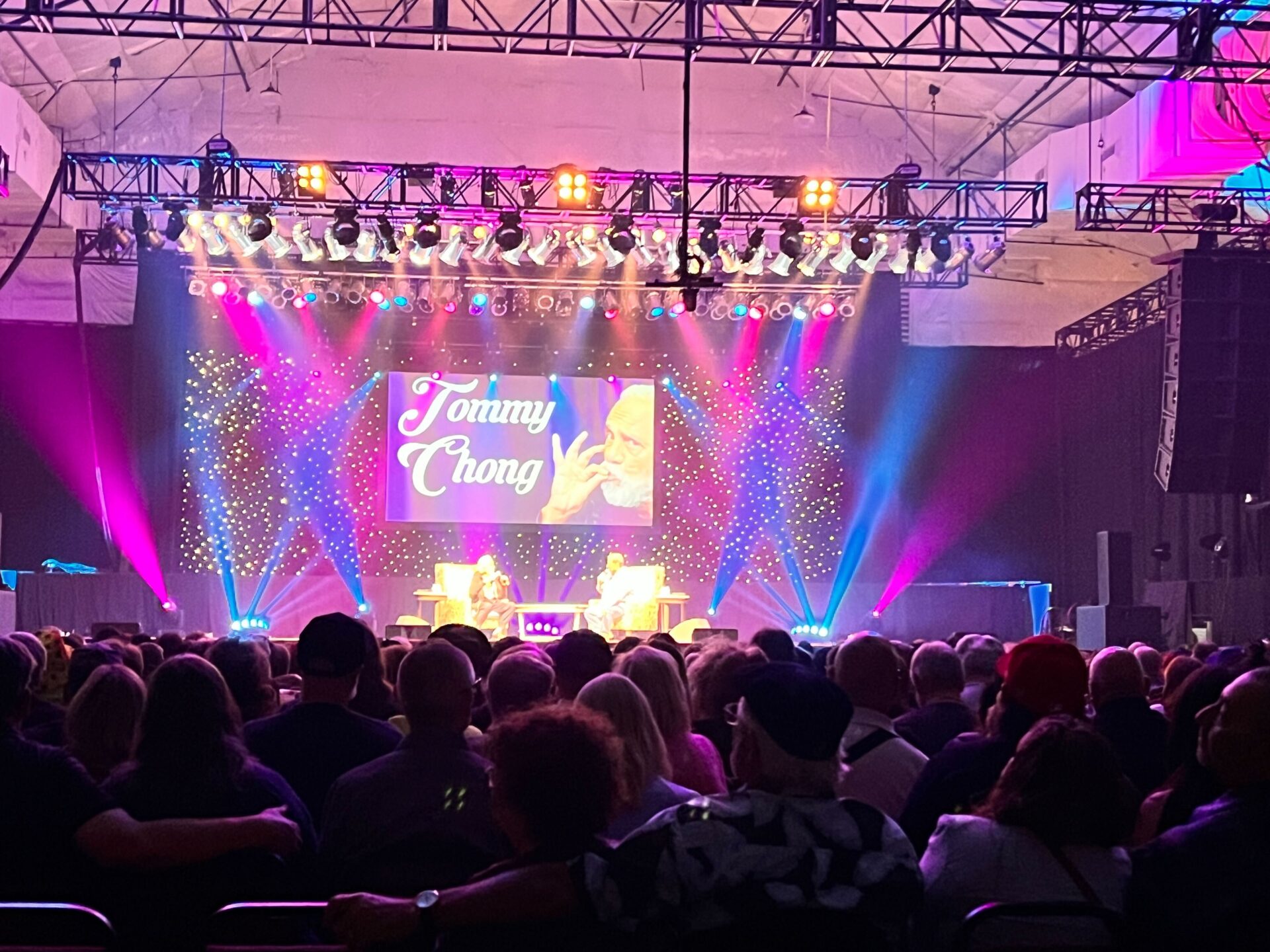
The contemporary stage photograph accompanying this article is archival live-event imagery from AV Vegas. It is not an image of the investigation, a courtroom or Chong’s imprisonment. That distinction keeps a recognizable face from substituting for the historical evidence beneath it.
For the broader cultural conversation, the High Rise media directory offers routes into cannabis reporting and storytelling. Bring the same attention to dates and perspectives wherever the story appears. A retrospective can be compelling while still making clear which parts come from officials, advocates or the person at its center.
Operation Pipe Dreams leaves us with a concrete piece of cultural history: glass businesses became the subject of a coordinated federal action, and Chong’s sentence carried that action into popular memory. Remembering the surrounding trade gives the story its depth. The glass was never just background scenery.