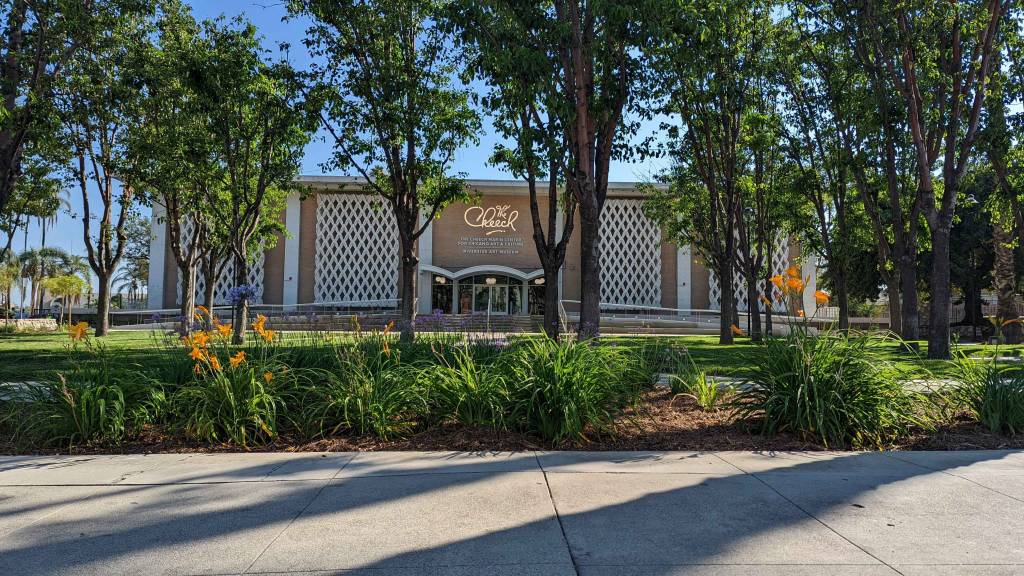
Cheech Marin’s name gets people to the door. The artists give them a reason to stay. At The Cheech in downtown Riverside, a collection built by a familiar counterculture figure has become a public home for Chicano painting, photography, sculpture and other forms of work.
The current first-floor exhibition makes the scale of that ambition clear. We the People: Chicano Art in the U.S.A. brings together sixty artists under curator Benito Huerta. It runs through May 23, 2027, giving Southern California readers a concrete reason to look beyond the celebrity name above the entrance.
The collection needed somewhere to live
The route to a permanent center began with an exhibition. In 2017, Riverside Art Museum presented Papel Chicano Dos: Works on Paper from the Collection of Cheech Marin. The museum’s history identifies sixty-five works by twenty-four artists, spanning watercolor, aquatint, pastel and mixed media.
That range matters. “Works on paper” can sound like a narrow category until the techniques start multiplying. A collection can connect artists through a shared cultural conversation while leaving room for very different ways of making an image. The institution that eventually followed would give that conversation a lasting address.
The exhibition led to a partnership among Marin, Riverside Art Museum and the City of Riverside. Under the arrangement described in the museum’s institutional history, Marin’s collection would be donated to RAM, while RAM would provide staffing, management, marketing and curatorial services for the new center.
The Cheech opened in June 2022. Its full name, The Cheech Marin Center for Chicano Art & Culture of the Riverside Art Museum, contains the important relationship: a collector’s contribution became part of an institution with its own curatorial responsibilities. The name on the building opens a larger story.
Start with the artists on the first floor
The current exhibition considers immigration, community life, borders, migration and documentation. Those themes connect it to questions people carry into the gallery from outside. The work does not need to be reduced to a single definition of identity for the conversation to hold together.
Huerta’s sixty-artist selection includes Carmen Lomas Garza, Carlos Almaraz, Patssi Valdez, Frank Romero, Narsiso Martínez, Sonia Romero and Vincent Valdez, among many others. A visitor can use those names as starting points. Following one artist across different works is a more rewarding exercise than treating a long roster as a checklist to finish.
The museum highlights Benjamin Muñoz’s A Miracle of the Masses, dated 2023, as acrylic on carved panel with relief printmaking collage. Sonia Romero’s Wings of the Dead, from 2015, combines laser-cut plexiglass and laser-etched wood with hand painting. Even the material descriptions show how much variety sits inside the exhibition.
Vincent Valdez’s Hello America, dated 2025, uses intaglio gravure with embossed titling and hand coloring in pencil. Put those three descriptions beside each other and the category becomes more expansive: carving, printing, cutting and drawing can all participate in the same exhibition without becoming interchangeable techniques.
That gives a first-time visitor a useful way in. Pick one work and ask what its materials contribute. Then move to something made differently. The comparison can begin with what is physically there, before a visitor feels obliged to arrive with a complete vocabulary for every movement, artist or historical reference.
A collection and an exhibition do different work
The center houses hundreds of paintings, drawings, photographs and sculptures. Its institutional description connects Chicano art’s roots in the movements of the 1960s and 1970s with contemporary responses to social conditions and wider artistic developments. That is a broad field for any one exhibition to explore.
A collection preserves the possibility of several exhibitions. A curator chooses a particular arrangement of works, themes and relationships for a particular presentation. Keeping those two functions separate makes a visit more interesting: what is on the wall today is a considered view into a larger body of work.
It also keeps the celebrity connection in proportion. Knowing Marin as a performer may prompt the first visit. Once inside, the individual artists deserve their own attention. The most useful question becomes who made a work, what they chose to put into it and what changes when it sits beside another artist’s work.
High Rise’s story on cannabis mylar becoming fine art follows a different route into exhibition culture. The connection is an invitation to look carefully at objects and images people might otherwise dismiss quickly. Each exhibition asks its audience to look again.
There are other ways for an artist to open a cultural history to a wider audience. Our feature on Fab 5 Freddy’s Grass Is Greener follows a filmmaker working through music, interviews and archives. At The Cheech, the exhibition gives individual artworks that responsibility.
The Inland Empire gets a place in the conversation
The Altura Credit Union Community Gallery gives the center a specific regional commitment. The museum describes it as a space for artists and curators from the Inland Empire, with the aim of reflecting the region’s stories. Riverside is more than the location where a collection happened to find an available building.
That local emphasis changes the relationship between a destination and its surroundings. Someone making the drive from Los Angeles can encounter work connected to the place they have entered. Someone who lives nearby can see the region represented within an institution carrying a widely recognized name.
A gallery’s value also lies in the questions it leaves a visitor wanting to pursue. Learn a name, look for another work and notice which materials or subjects keep returning. A visit can become the beginning of an interest that continues after leaving the gallery.
There is a parallel in the independent publishing covered in our Broccoli magazine feature: editors and curators create room for a range of contributors. Their choices shape what an audience encounters. The artists and writers inside that space still bring distinct voices of their own.
Keep the two museum addresses straight
The Cheech is at 3581 Mission Inn Avenue. Riverside Art Museum’s other building is at 3425 Mission Inn Avenue. Both appear in the organization’s programming, so confirm which building holds the exhibition you want to see. We the People is identified specifically with The Cheech’s first-floor galleries.
Use the official visit and ticket pages for current opening hours, admission options and any date-specific changes. An exhibition’s closing date is not a promise that every day before it is an open day. The same care applies when combining a gallery visit with a separate talk, screening or community program.
Allow the art to set the pace. Sixty featured artists are a reason to leave some room in the day, not a challenge to claim mastery of an entire exhibition in one pass. A few works given sustained attention can leave a stronger impression than a hurried circuit of every wall.
The current art season reaches beyond the doors
A November 4 City of Riverside announcement adds another strand to the season. It describes eight twenty-foot Alebrijes and Nahuales sculptures created by Mexican folk artists, with an unveiling planned for November 5. The city announced display through early January 2027 across five locations, including The Cheech.
The other named sites are Riverside Art Museum, Riverside City College, Bordwell Park and the Arlanza Community Center. That is a citywide presentation. It should not be mistaken for eight sculptures promised inside The Cheech’s galleries. Check the city’s exhibition announcement and current venue information before building a route around an individual installation.
The public-space program and We the People offer different encounters with art. One sends attention outward across Riverside; the other brings a curator’s selection into the first-floor galleries. Together, they give the city a fuller cultural itinerary than a single famous name might suggest.
That is the reason to make time for The Cheech. Start with a familiar name, then give the artists room to complicate the picture. Their work is the destination.