A cannabis museum can change what you notice in an ordinary object. A rope becomes part of agricultural history, while a painted tavern becomes a debate about public behavior. A magazine cover becomes evidence of how a community represented itself.
The Hash Marihuana & Hemp Museum, with locations in Amsterdam and Barcelona, gives those objects a shared home. Its collection stretches well beyond consumption. That breadth is the reason to pay attention, even if your usual cannabis reading starts with a cultivar name or a new piece of glass.
The museum’s published catalog and history provide a way to explore those connections before a visit. Familiar cannabis culture starts to look different when you place it beside objects from other times, made for purposes that reach well beyond today’s dispensary shelf.
A personal collection becomes a public argument
The museum’s own history dates its Amsterdam opening to 1987. It credits Ben Dronkers and Ed Rosenthal with establishing the original Cannabis Info Museum. The institution describes that project as a way to share a collection and challenge prevailing ideas about the plant.
That origin tells you something about the museum’s perspective. It grew from people invested in cannabis, rather than from a neutral warehouse of unrelated objects. Knowing that makes the collection easier to read critically. You can appreciate its purpose while still asking how each individual claim is supported.
A museum does not need to hide its point of view to be worth visiting. It needs objects, context and enough detail for visitors to form their own judgments. The distinction matters in a subject where advocacy, commerce and historical memory often occupy the same room.
The scale is in the range of objects
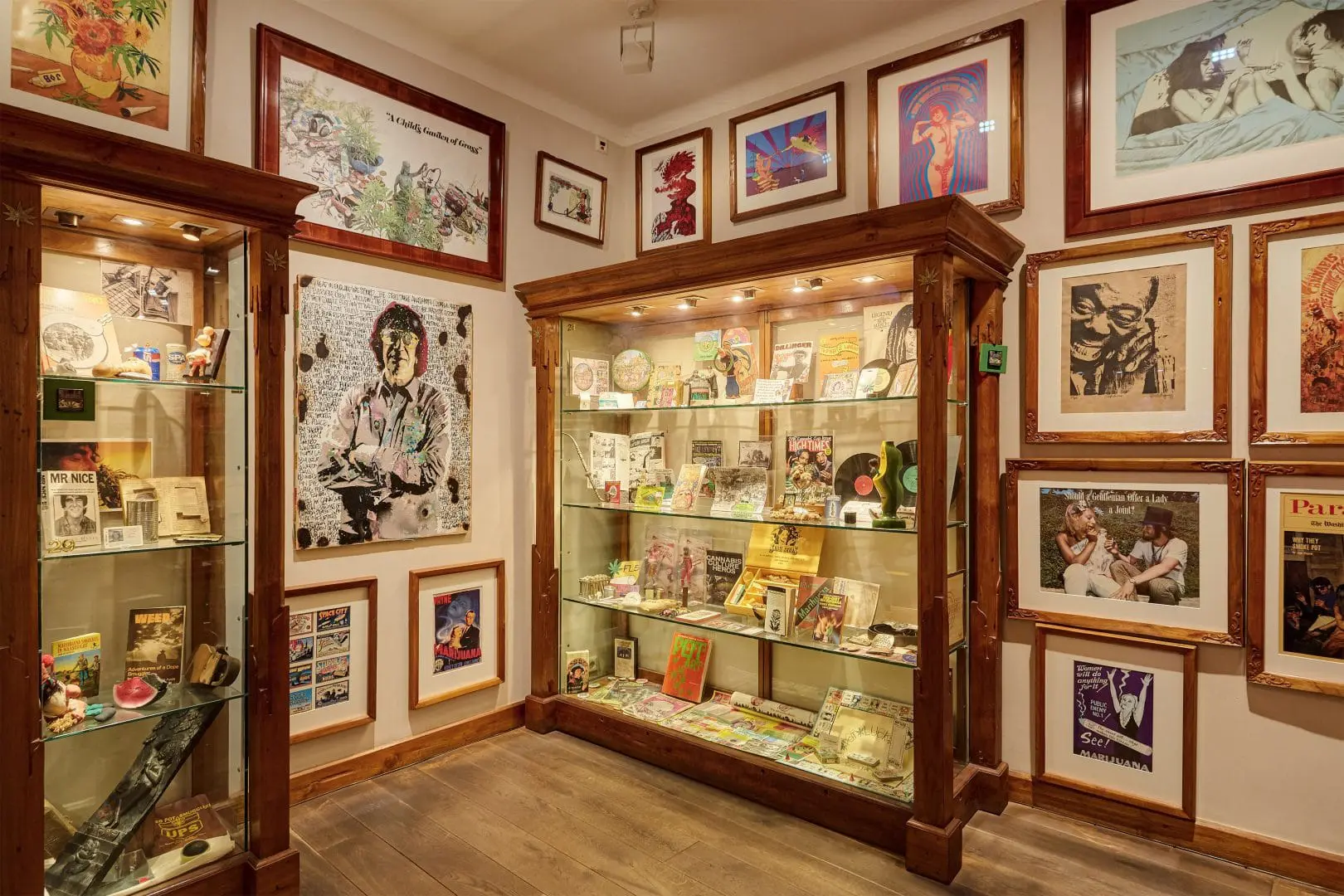
The collection overview describes more than 9,000 items. Its examples include botanical prints, hemp tools, textiles, pipes, historical medicine bottles, paintings and popular-culture material. That figure describes the collection, not a promise that every object is displayed simultaneously.
The variety creates a better starting point than a timeline built only around legalization. Cannabis has appeared in work, trade, representation and everyday material life. A textile and a magazine do not tell the same story, even when the plant connects them.
Historical medicine packaging should also be read as historical evidence. A bottle can show how something was labeled or sold in its period. Its presence in a display is not a modern health recommendation, and it does not validate every claim printed on its label.
That habit of separating an object from a claim applies throughout the collection. Ask who made it, when it circulated and what the museum can establish about its use. The questions make the visit richer without requiring a history degree or a rehearsed opinion.
The paintings are doing more than documenting a smoke
The museum’s Old Masters section includes works associated with artists such as Hendrick Sorgh and David Teniers the Younger. It discusses seventeenth-century smoking scenes in relation to social customs and moral judgments.
Crucially, the museum cautions against treating those scenes like documentary photographs. A painted tavern may organize behavior into a moral story. The picture can reveal an attitude toward smoking without proving every detail a modern viewer wants to find inside it.
That makes the room more interesting than a search for old pictures of people getting high. Look at who occupies the center, who observes from the edge and how the scene directs your attention. The composition itself is part of the evidence.
It is also a useful check on contemporary habits. We are comfortable reading a modern cannabis photograph as a constructed image. Historical art deserves the same care because a compelling scene is still something someone chose to make.
Hemp moves the story outside the smoke room
The shipping collection connects hemp with sails, rigging and the work of making wooden vessels watertight. Its account brings the plant into maritime infrastructure, where utility mattered more than a retail identity.
Rope is easy to overlook because it appears ordinary. Put it beside a ship painting and an agricultural tool, though, and a network begins to emerge. Materials had to be grown, processed, transported and maintained, and the finished object carries traces of that labor.
That perspective broadens a cannabis conversation without forcing every historical use into a modern product pitch. A material can be important in one setting without becoming the perfect answer to every present-day problem. The historical connection is interesting on its own terms.
For visitors used to jars and branded packaging, this is a useful change of scale. The plant stops being only an individual purchase and becomes part of the machinery of a society. A small object can point toward a much larger system.
Hash-making tools keep the craft visible
In its hash-making section, the museum presents equipment and illustrations connected with different production traditions. The emphasis on tools helps preserve the work behind a finished material, rather than allowing the final object to stand alone.
Tools are useful historical witnesses because they ask practical questions. What task was a maker trying to perform, and which parts required repetition, judgment or physical skill? How did the available materials shape the method? Those questions bring people back into a discussion that can otherwise become only terminology.
Modern concentrate culture has its own vocabulary and equipment. Our history of 710 and concentrate culture provides a different, more recent point of entry. Reading the two together helps keep a contemporary scene connected to a longer craft history.
There is no need to turn a museum display into instructions for production. The value here is recognizing that a familiar category contains multiple traditions. A shared name does not erase differences in place, process or the people doing the work.
Counterculture leaves a paper trail
The counterculture section brings posters, publications and other popular objects into the collection. These materials show cannabis moving through visual culture and public identity, rather than appearing only in laws or scientific classifications.
A poster has a job in the moment it is made, whether that involves advertising, persuasion or helping people recognize one another. Decades later, its lettering, distribution and assumptions can become as revealing as its headline. Keeping the paper preserves more than the slogan.
That is why recent cannabis artwork belongs in a serious cultural conversation too. High Rise’s feature on cannabis mylar as fine art approaches a present-day object from another direction. Both subjects ask what packaging and printed material can reveal once we stop treating them as disposable background.
The comparison does not make every bag a museum piece. It does suggest a useful question: what will future readers need to understand the object? A date, maker’s name and original context may matter more than a dramatic story added later.
Two buildings give the collection different settings
The institution presents its Amsterdam location as a canal-house museum and its Barcelona location inside Palau Mornau. The Barcelona visitor page describes the palace’s architectural history, including a 1908 refurbishment by Manuel Raspall and a major restoration in 2012.
The building is part of the experience, but practical details still deserve attention. Barcelona’s page explicitly notes access limitations connected with the historic structure. Check the current location page before planning a visit, particularly if step-free access is important to your group.
Hours, temporary exhibitions and ticket arrangements can change, making the museum’s visit information the right place for those decisions. A culture feature should help you understand why a collection matters without turning an old schedule into travel advice.
Bring the habit of looking closely home
The museum’s strongest invitation is to examine familiar things more carefully. A label, tool or photograph can hold several histories at once. Those histories become clearer when the maker, place and date stay attached to the object.
The same approach works beyond a museum, so when browsing High Rise’s strain-library overview, notice the names and relationships behind the listings. When reading a brand feature, look for the people doing the work. Cannabis culture becomes larger when we keep those connections visible.
A room full of objects cannot tell every cannabis story, but it can make the missing stories easier to notice. That is a good reason to leave space between the latest release and the next one, and spend some time with what the culture has already left behind.