An electric grinder comparison becomes useful when it separates the jobs each machine actually performs. OTTO, Wakit and Mamba all add a motor, but they organize the work differently. Their controls, output paths and maintenance demands deserve more attention than an unsupported winner's badge.
This comparison covers the OG OTTO, Wakit Black third generation and Mamba Original specifically. We checked manufacturer product and support pages on October 13, 2026. The analysis uses documented hardware details, with current prices treated as dated observations. It does not report a new High Rise bench test.
Start with the exact three models
Model names matter because each company has products that can easily enter the wrong comparison. OTTO GO is a separate listing, while Wakit also sells Mini Wakit and RollBotz. Mamba's catalog includes several sizes and designs beyond the Original discussed here.
| Comparison point | OG OTTO | Wakit Black 3rd Gen | Mamba Original |
|---|---|---|---|
| Core mechanism | Automatic milling plates | Motor-driven ball and chain | Motor-driven teeth |
| Main control distinction | Automatic adjustments | Tap activation | Forward/reverse rocker |
| Output arrangement | O-Tube attachment | Separate tube accessory | Cone-shaped dispensing tip |
| Observed price | $89.95; sold out | $59.99 accessory bundle | $39.99; Add to cart |
| Published power connection | Micro-USB | Micro-USB | USB rechargeable |
The table describes the specific listings checked, with shipping and taxes outside the displayed prices. It does not establish identical package contents or guarantee that any listing remains available. A low displayed price has limited practical value when the selected model cannot ship.
Mechanism: three different approaches to automation
The OG OTTO product page describes aluminum milling plates and automatic changes to direction, speed and pressure. Its O-Tube connects beneath the body, bringing milling and filling into one arrangement. That integration is the main design difference to understand before comparing smaller details.
Integration can reduce the number of separate objects in one part of a setup. It also makes the attachment and its compatibility part of the ownership decision. Readers wanting more background on that design can consult our dedicated OTTO review.
Wakit's third-generation listing instead describes a ball-and-chain mechanism activated through short taps. Its separate tube accessory should not be confused with a built-in milling-and-filling system. The brand's distinction between Wakit and RollBotz also matters when reading accessory descriptions.
Mamba Original uses anodized aluminum teeth, a forward/reverse rocker and a cone-shaped dispensing tip. Direction is an explicit user control in this design. The current page calls the product a seed and spice grinder, despite the older version language in its URL.
These mechanisms explain different interfaces, but they do not establish which produces a better result. A defensible texture comparison needs matching material, measured inputs and a stated assessment method. None of those controls appears merely because a product page uses words such as precision.
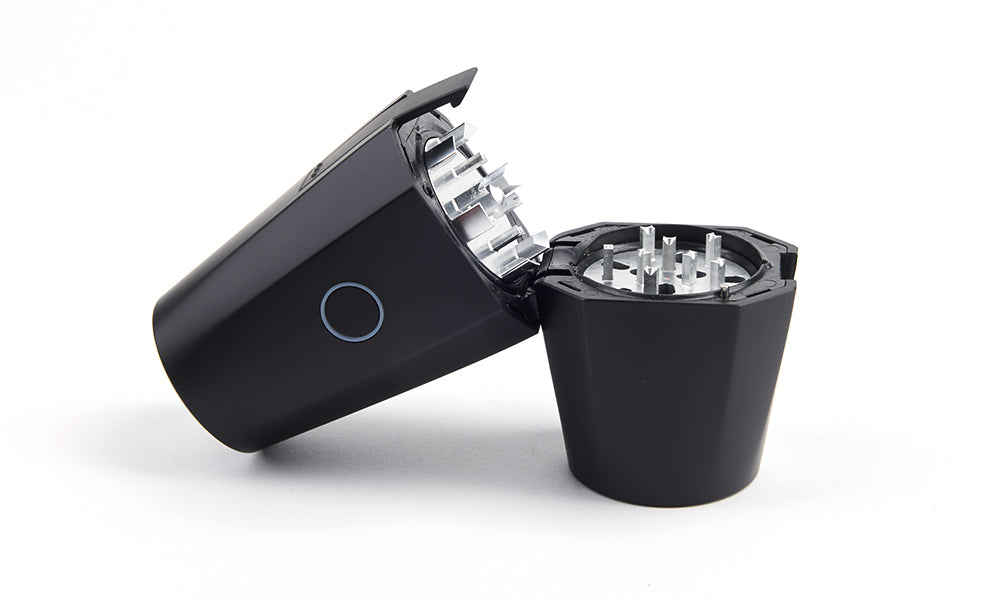
Open OG OTTO. Manufacturer image courtesy of banana bros.
Controls: decide what you want the machine to manage
The interface question is more specific than whether electric operation sounds easier than manual turning. Some people prefer automatic adjustments; others want a direct control over the motor's direction. Those preferences can lead to different choices without either person misunderstanding the same specifications.
Look beyond the main button when judging a device's overall handling demands. Opening the chamber, managing attachments and caring for the parts remain separate ownership tasks. A claim about one-handed activation cannot establish that every task requires only one hand.
That is also why we avoid translating a control layout into a medical benefit. A feature description cannot prove suitability for an individual mobility limitation or health condition. Our electric-versus-manual comparison explores the broader tradeoff between powered convenience and a simpler mechanical setup.
Prices and availability need their own context
OTTO's checked listing showed $89.95 alongside a crossed-out $159.99 price and a sold-out label. Wakit's $59.99 figure applied to the third-generation bundle with a tube accessory and brush. Mamba Original displayed $39.99 with an Add to cart control on its current page.
The Wakit page also showed a $54.99 grinder component inside the bundle description. That figure should not silently replace the bundle's displayed total in a comparison. The same page contained contact-to-order text alongside Add to cart, leaving fulfillment worth confirming directly.
These are snapshots of manufacturer listings, not promises about future stock or final checkout totals. They also do not prove which package has the lowest long-term ownership cost. Accessories, replacement parts and a warranty's actual scope can change that calculation over time.
Power claims do not share a common yardstick
Both the OTTO and checked Wakit listings identify Micro-USB charging connections for their included cables. Mamba's FAQ confirms an internal USB-rechargeable lithium-ion battery without identifying the connector there. We therefore do not assign a specific USB connector to Mamba from that wording alone.
Banana bros.' FAQ states a 45-minute charge time and at least 20 fills per charge. Mamba's product page claims three hours of continuous operation from a full charge. Those figures describe different measures, so dividing or ranking them would create false precision.
Wakit's FAQ supplies a material-weight-based estimate that likewise cannot be compared directly with those figures. We have no common test establishing runtime, charging speed or battery aging across all three. Battery capacity alone would also be insufficient to establish a real-world endurance winner.
Size and storage: the missing measurements matter
We did not verify a consistent set of bare-device dimensions across these three current listings. Wakit's bundle lists 19 ounces and dimensions of 8.75 by 5.75 by 5.75 inches. Those numbers are attached to the bundle, without clearly identifying the grinder alone.
Calling Wakit a 19-ounce device would turn ambiguous catalog metadata into an unsupported portability claim. Assigning missing measurements to the others from similar-looking models would create the same problem. If precise storage fit matters, obtain dimensions for the exact model and its required attachments.
Photographs can explain shape, but an image without a reliable scale cannot settle a size comparison. A handle, upright body and separate base imply different storage arrangements without proving relative compactness. Leave space for that uncertainty instead of giving an unmeasured product a portability crown.
Care and support are part of the hardware comparison
OTTO's instruction guide describes its supplied tool for clearing and brushing the milling plates. It also identifies a safety-switch area that needs attention and warns against wetting the appliance. The internal battery is nonreplaceable according to that guide.
Wakit's FAQ separates routine brush or dry-cloth care from a moistened alcohol towelette. It explicitly warns against water or liquids inside the grinder. The company also specifies that Wakit and RollBotz replacement chains differ, making exact part identification necessary.
Mamba's FAQ distinguishes its detachable metal head from the motorized body when describing care. It specifies a light alcohol wipe for the head and a swab for the apparatus. These component-specific directions do not authorize soaking a powered device or applying another model's cleaning routine.
The warranty periods differ too, but duration alone cannot establish better service. Banana bros.' current policy gives eligible direct-site purchases one year of limited coverage. It directs Amazon purchases to Amazon's process and excludes water damage, misuse and normal wear.
Wakit specifies six months of limited defect coverage and registration within 14 days of purchase. Mamba lists a two-year limited manufacturer's warranty, with marketplace return requests directed to the selling platform first. Neither policy establishes the actual response or replacement time for a future individual claim.
What the available hands-on history can actually establish
There is a historical High Rise connection here, but its limits deserve clear treatment. Mamba published an April 26, 2024 article about a HighRise TV review, explicitly naming the V1. A manufacturer-uploaded Vimeo page identifies Macdizzle's Mamba review.
That archive establishes a named review's existence, not a current three-model laboratory comparison. We did not analyze the underlying video for this article or independently confirm its performance claims. The older model label further limits what can responsibly transfer to today's Mamba Original listing.
A new comparative test would need the exact retail models, repeated trials and clearly documented conditions. It would also need separate observations for control effort, output consistency, cleanup and endurance. Until that evidence exists, manufacturer specifications remain specifications rather than our own measured results.
Choose the design priority before choosing a winner
OTTO is the integrated milling-and-filling option here, subject to its observed sold-out status. Wakit represents the ball-and-chain approach, with a bundle whose accessory terms need careful reading. Mamba Original pairs a directional rocker with a dispensing head at the lowest observed displayed price.
Start with the interface and physical arrangement that solve your actual hardware problem. Then check current availability, exact package contents, care requirements and the applicable support route. That sequence is more useful than treating a temporary discount as the whole comparison.
Our broader electric grinder guide adds other designs when these three do not fit your priorities. Within this comparison, the strongest conclusion concerns their different approaches to control and output. A universal performance winner would require evidence this research does not provide.