The Sisters of the Valley gallery asks you to look twice. An image of Brigid of Kildare appears beside photographs of Sister Darcy, the modern woman who inspired the rendering. Other cards make similar pairings. The habit is familiar, but the faces connect a chosen history with people doing the work now.
On their website, the Sisters describe a spiritual and activist community built around shared work, prayer and dress. Their public identity brings those commitments into a California cannabis setting. Understanding it means looking at the community’s own language, its named members and the images it chooses to keep.
The dress identifies an enclave
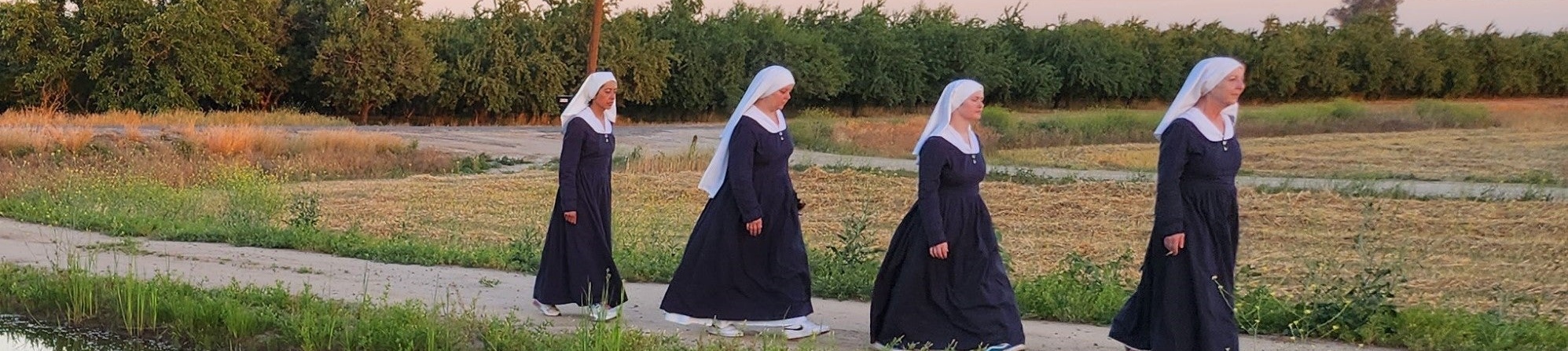
In the group’s account of its purpose, dress has a practical social role: it identifies the enclave. The white veils and recognizable clothing make a shared affiliation visible before anyone reads a mission statement. They also give the group a consistent presence across photographs of different people and different years.
The Sisters call themselves Beguine revivalists and describe their community as a new-age activist sisterhood. Those are their chosen terms. A viewer who recognizes religious clothing should not assume that the photograph explains the group’s beliefs, membership or institutional history on its own.
Their explanation connects dress with working and praying together. Each activity gives the visual identity another dimension. Clothing is what the camera can record immediately; a shared routine involves people returning to work, maintaining relationships and assigning responsibilities. The image introduces that arrangement without showing every part of it.
Other women-led cannabis spaces organize around different forms of participation. Blunt Brunch’s local and national gatherings, for example, bring people together through recurring events. The Sisters describe a spiritual community and its work. Keeping those forms distinct lets each tell its own story.
A California beginning, with several dates
The group’s history has more than one starting point. Its current biography of Sister Kate, identified as the founding abbess, dates an earlier nonprofit cannabis collective to 2009. It then places the founding of Sisters of the Valley in 2014. Those milestones describe different stages in her account.
The Sisters’ FAQ adds a commercial timeline: Kate grew the first crop for this business and made its first batch of products in 2014, with sales beginning in January 2015. The second Sister arrived nine months after the business began selling, according to the same account.
That sequence is useful because a recognizable group can appear fully formed in a photograph. The organization’s own chronology instead describes earlier work, a founding period and other people joining afterward. A single anniversary date cannot express all three.
The FAQ also locates the sisterhood’s activist beginnings in the Occupy movement. Its account places Kate’s first use of the nun identity in 2011, before the business and sisterhood dates above. The public persona, the group and the commercial operation therefore belong to connected, but different, parts of its story.
Beguine inspiration has a history of its own
The Sisters’ chosen reference leads outside California. UNESCO’s account of the Flemish béguinages describes medieval women who pursued religious lives while remaining connected with the wider world. Their communities addressed spiritual and material needs together, with houses, churches, other buildings and shared green spaces.
UNESCO places the founding of those Flemish communities in the thirteenth century. That gives readers a historical context for the idea of independent religious women living in organized communities. It does not establish an unbroken institutional line from medieval Europe to the present California group.
For the Sisters, the reference is part of a chosen identity. It joins spiritual practice with the stated aim of women having business and property ownership. The interesting connection is that attention to material life: how a community supports itself belongs beside what it believes.
Inspiration can also involve reinterpretation. The contemporary Sisters have their own declared vows, leadership roles and practices. Reading those details gives a clearer picture of their community than expecting a medieval reference to supply a complete rulebook for it.
Six vows give the community a vocabulary
The FAQ names six vows: service, obedience, living simply, activism, chastity and ecology. Their initials form SOLACE. The group specifically describes obedience in relation to the cycles of the moon, locating that word within its own spiritual framework.
These words make the community’s aspirations more specific than a general statement about togetherness. Service and activism point toward relationships beyond the group. Living simply and ecology describe values members are asked to carry into daily life. The vows are the Sisters’ account of their commitments, rather than an outside assessment of every member’s conduct.
Moon cycles also appear in the group’s descriptions of ceremonies and work. Here they belong to the explanation of spiritual practice. As described by the Sisters, those ceremonies mark a rhythm shared by the group. They place changes in the moon alongside the routines of its working life.
The FAQ’s description of a working week is less uniform than the familiar photograph might suggest. It mentions visitors, media, a staff meeting and individual responsibilities, with people also responding to the needs of others. That account leaves room for ordinary interruptions inside a deliberately structured community.
A sisterhood has work beyond its founder
Sister Camila is identified as founder of Sisters of the Valley Mexico and leader of Latin America. Her biography dates the Mexico enclave to 2018 and the Spanish-language branch, Las Hermanas del Valle, to 2023. Those are the organization’s stated milestones, rather than a count of every community active today.
Sister Esme’s role combines ministry and art. The website identifies her as Director of the Ministry, with responsibilities involving education, ceremony and internal community life. It also describes her illustrations and linework. Art appears as part of the ministry’s public identity.
The distinction between those roles helps put faces back into the group photograph. A shared habit does not make everyone’s work identical. Administration, language, ceremony and visual expression give the sisterhood several ways to organize and communicate, alongside the founder’s public role.
The gallery makes its visual method visible
The collectible-card gallery credits Lillian the Artist with rendering images inspired by photographs of actual Sisters. It presents the card first and the photographs behind it afterward. The page therefore explains the relationship between the modern face and the historical or symbolic figure.
Sister Darcy inspires Brigid of Kildare; Sister Eevee inspires Hadewijch of Brabant; Sister Kate inspires Mechthild of Magdeburg. These are artistic pairings named by the gallery. They are not photographs of the historical women, and the website does not ask readers to mistake them for that.
The listed deck includes eight matriarch cards, two enclave cards, two goddess cards and a sesh card. That mixture places individual figures beside the community and a shared activity. The portraits work as a collection, with the Sisters’ own photographs providing a visible connection between its parts.
Cannabis culture takes other forms on the page, too. Our feature on Broccoli’s independent print work follows a different approach to choosing what belongs in the frame. Here, the pairing of card and source photograph lets the Sisters explain a piece of their visual identity themselves.
Go past the nickname
The group has also been a documentary subject. Film Constellation’s Breaking Habits listing credits Robert Ryan as director and Nick Taussig and Paul Van Carter as producers. A film supplies another authored perspective; it should not be confused with the group’s own gallery or present-day account.
For another example of keeping those perspectives identifiable, Frenchy Cannoli’s public archive brings films and their provenance into view. Names, dates and authorship help a cultural record retain its texture as individual images travel beyond their original setting.
The Sisters’ habit is an effective introduction. The gallery, the stated vows and the named responsibilities make it possible to stay for a fuller story. Behind the recognizable clothing are people choosing how to work together and how they want that work to be seen.